The Financial Front: How Malicious NuGet Packages are Targeting Stripe API Tokens
The Price of a NuGet Import
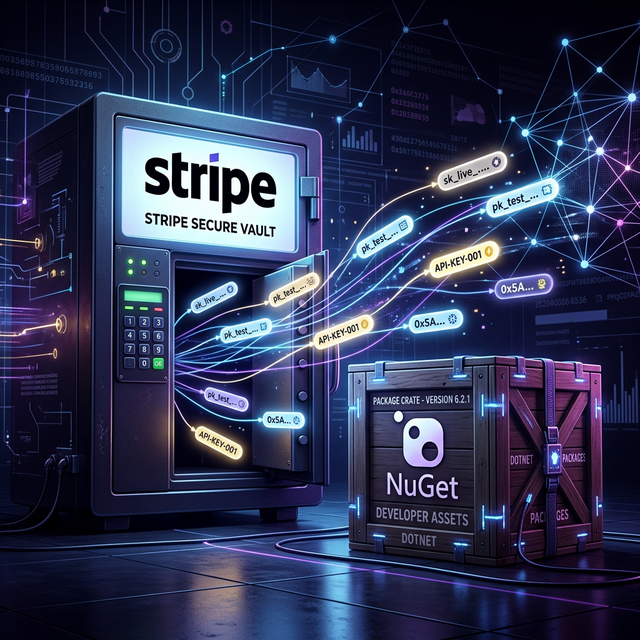
For .NET developers, NuGet is the lifeblood of productivity. But a new wave of malicious packages, designed specifically to target e-commerce and fintech applications, is turning that productivity into a liability. These packages are engineered to search for and exfiltrate Stripe API tokens, giving attackers total control over a company's financial transactions and customer billing data.
Your "checkout" page might be paying a hacker instead of your business.
The Anatomy of the Stripe Theft
The malicious code is often hidden in "helper" packages for processing payments or managing customer sessions. Once the package is integrated into a web application, it begins scanning the environment variables and configuration files for strings that match the Stripe secret key format (sk_live_...).
Real-Time Financial Hijacking
In more advanced versions of the attack, the malware doesn't just steal the key; it hijacks the Stripe Webhook listener. This allows an attacker to "approve" fake transactions, redirect refunds to their own accounts, or silently copy the credit card details of every customer who makes a purchase.
Evasion via Obfuscation
The malicious code is never visible in the source repositories. It is "injected" during the CI/CD pipeline or hidden deep within the binary DLL files of the NuGet package. This makes it invisible to standard "source code" scanners.
Hardening Your Financial Pipeline
Protecting your revenue requires more than just code reviews. Here is the Grivyonx strategy for financial API security:
- Restricted API Scoping: Use Stripe's "Restricted Keys" feature. A key that is meant to only read data should not have the permission to issue refunds or create charges.
- Runtime Credential Monitoring: We help you implement monitoring that alerts you the moment a "Live" Stripe key is accessed by an unauthorized process or sent to an external domain.
- Static Analysis of Binaries: Go beyond scanning your source code. We help you implement binary analysis tools that "look inside" the Compiled DLLs of your third-party packages for malicious intent.
The Grivyonx Perspective
At Grivyonx Cloud, we are specialists in Fintech Security and API Governance. We understand that in the financial world, data is money. We provide the expertise and the monitoring needed to ensure that your payment pipelines remain pure and your revenue remains yours. The financial front is high-stakes. Let's protect your bottom line together.
- #cybersecurity
- #NuGet
- #malware
- #API security
- #supply chain attack
- #developer security



