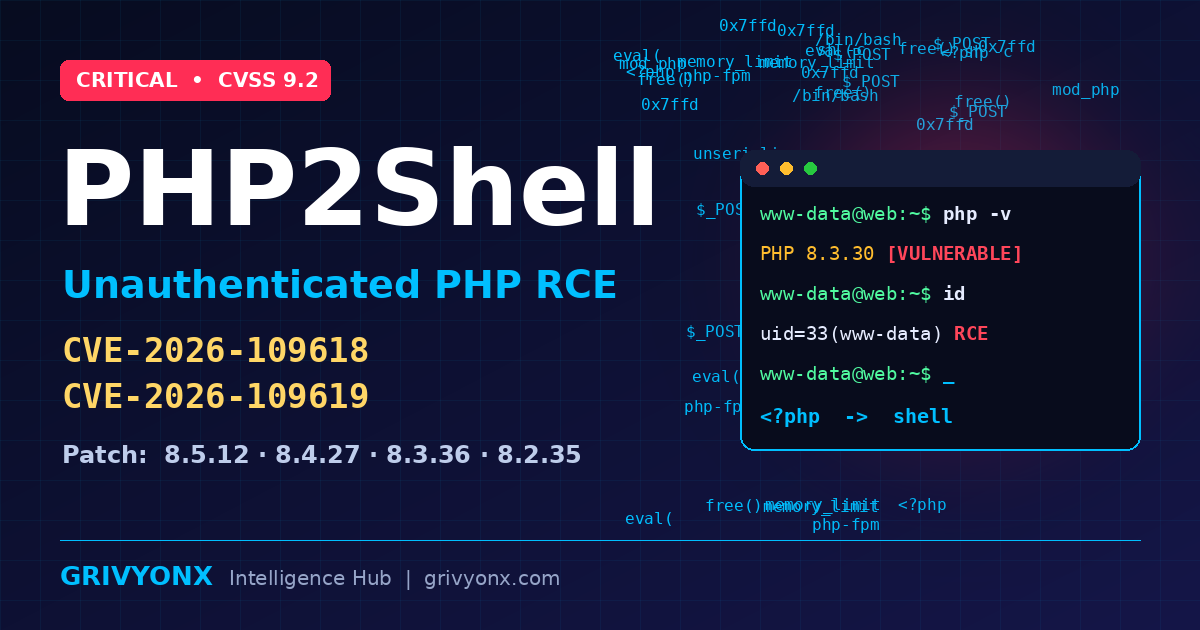
PHP Patches Critical RCE Vulnerabilities

Introduction
The PHP Foundation has issued urgent security updates to resolve seven critical vulnerabilities within the PHP ecosystem. Among the most severe is a flaw that could grant attackers the ability to execute arbitrary code remotely on affected servers. For organizations relying on PHP to power their web applications and backend services, these updates represent a mandatory security baseline to prevent full system compromise.
Analyzing CVE-2026-115560 and RCE Risks
The most prominent vulnerability in this release is identified as CVE-2026-115560, which carries a critical CVSS score of 9.2. This flaw stems from improper input validation, a common but dangerous security gap where the application fails to sufficiently sanitize data provided by a user or external source before processing it.
When exploited, this vulnerability allows an attacker to achieve Remote Code Execution (RCE). The implications of RCE are severe, as it typically allows an adversary to run commands with the privileges of the web server process. Beyond simple code execution, the source material indicates that this specific flaw could also lead to unauthorized file modification, potentially allowing attackers to deface websites, inject malicious scripts into legitimate files, or create backdoors for persistent access.
Scope of the Vulnerabilities
While CVE-2026-115560 is the primary focus due to its high severity score, the PHP Foundation has addressed a total of seven critical flaws in this security cycle. The collective nature of these bugs suggests a broad attack surface that could be targeted by automated scanners or sophisticated threat actors. Because PHP is one of the most widely deployed server-side languages globally, the potential impact of these vulnerabilities spans across millions of servers, from small business websites to enterprise-grade cloud deployments.
Grivyonx Expert Analysis
A CVSS score of 9.2 indicates a vulnerability that is likely easy to exploit and has a devastating impact. In the context of PHP, improper input validation often points to a failure in how the engine handles specific data types or unexpected characters in a request. For security engineers, this underscores the danger of relying solely on application-level sanitization; the underlying runtime environment must also be hardened. The ability to modify files via RCE means that even if your application code is secure, a vulnerability in the PHP core can bypass all your logic and compromise the entire host OS.
Immediate Mitigation and Defense Strategies
To protect their infrastructure, IT and security professionals should take the following actions immediately:
- Update PHP Versions: The primary and most effective defense is to update all PHP installations to the latest patched versions released by the PHP Foundation.
- Audit Input Vectors: While the patch fixes the core issue, developers should review their own code for areas where user-supplied data is passed to sensitive PHP functions.
- Implement Least Privilege: Ensure that the user account running the PHP process has the minimum necessary permissions. This limits the damage an attacker can do via file modification even if an RCE vulnerability is exploited.
- Deploy Web Application Firewalls (WAF): Use a WAF to detect and block common RCE patterns and suspicious input strings while the patching process is underway across the fleet.
Conclusion
The discovery of seven critical flaws, particularly those allowing remote code execution and file modification, serves as a reminder of the volatility of the modern software supply chain. Timely patching is the only guaranteed way to close these gaps and protect sensitive data from exploitation. Maintaining a robust security posture requires a combination of rapid patch management and integrated DevSecOps practices, similar to the AI-driven automation and cloud security frameworks championed by Grivyonx Technologies.
- #PHP
- #Cybersecurity
- #RCE
- #Vulnerability Management
- #Web Security
- #CVE-2026-115560