PHP2Shell Exploitation Hits Government Entity Amid AI-Assisted

Introduction
Security researchers have identified a concerning escalation in the exploitation of PHP2Shell vulnerabilities, with threat actors leveraging agentic artificial intelligence platforms to accelerate post-exploitation activities. The campaign has already compromised a European government entity, demonstrating how AI tools are being weaponized to reduce the time between initial access and credential theft.
PHP2Shell Vulnerabilities Under Active Exploitation
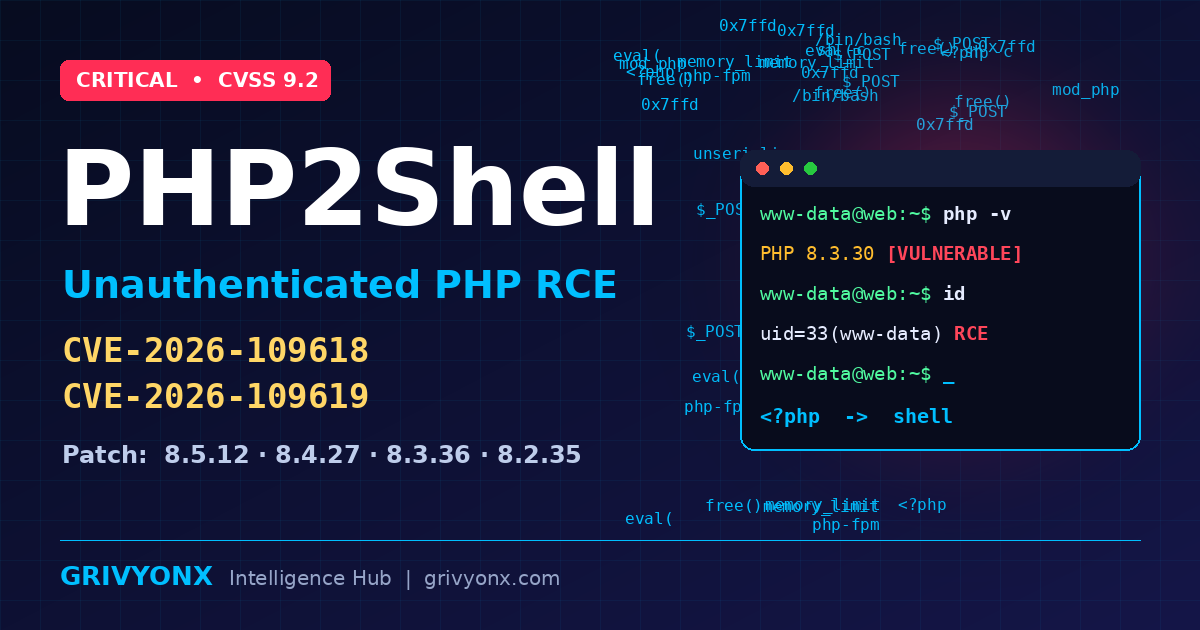
The attack chain centers on two PHP2Shell vulnerabilities currently tracked as CVE-2026-109618 and CVE-2026-109619. While specific technical details of these flaws remain under analysis, their exploitation has enabled threat actors to gain initial footholds in target networks with alarming speed. The vulnerabilities appear to affect PHP-based web applications, making them particularly dangerous given the widespread deployment of PHP in enterprise and government environments.
Global scanning activity has surged in recent weeks, with automated tooling probing for vulnerable PHP2Shell instances across multiple sectors. This reconnaissance phase suggests the attackers are methodically identifying targets before deploying their AI-enhanced exploitation toolkit.
Rapid Post-Exploitation Using AI Platforms
What distinguishes this campaign is the attackers' use of agentic AI platforms to orchestrate post-exploitation activities. Within two hours of the initial exploitation at the European government entity, the threat actors had successfully accessed password hashes and multi-factor authentication credentials. This compressed timeline represents a significant evolution in attack methodology, where AI automation eliminates traditional manual steps that previously slowed down lateral movement and privilege escalation.
The AI platforms appear to be handling tasks such as network enumeration, credential harvesting, and persistence mechanism deployment. By automating these processes, attackers can maintain operational tempo that outpaces conventional incident response workflows.
Global Scanning and Target Expansion
The exploitation of the European government entity is not an isolated incident. Intelligence indicates coordinated global scanning operations targeting PHP2Shell vulnerabilities across multiple regions. These scanning efforts suggest a broader campaign infrastructure designed to identify and prioritize high-value targets.
Government entities, critical infrastructure operators, and large enterprises running PHP-based applications are considered at elevated risk. The combination of widespread vulnerability exposure and AI-accelerated exploitation creates a threat landscape where traditional defense timelines may no longer provide adequate protection.
Mitigation Strategies for Security Teams
Organizations should immediately audit their PHP-based applications for PHP2Shell implementations and verify patch status against CVE-2026-109618 and CVE-2026-109619. Network segmentation and strict egress filtering can help limit lateral movement if initial compromise occurs.
Security teams should also enhance monitoring for anomalous authentication patterns and credential access attempts, particularly those exhibiting AI-driven speed and precision. Implementing zero-trust architecture principles and deploying advanced endpoint detection and response solutions can provide additional layers of defense against accelerated attack chains.
Grivyonx Expert Analysis
The PHP2Shell exploitation campaign highlights a fundamental shift in threat actor capabilities, where AI platforms compress attack timelines from days to hours. Traditional signature-based defenses are insufficient against adversaries leveraging AI for automated reconnaissance and exploitation. Organizations must adopt proactive threat hunting strategies and implement AI-powered security solutions to match the sophistication of these evolving attacks. The integration of AI in both offensive and defensive operations is creating an arms race that demands immediate attention from security leadership.
Conclusion
As threat actors continue to weaponize AI platforms for rapid exploitation and credential theft, the cybersecurity community faces an urgent need to adapt defensive strategies accordingly. The PHP2Shell campaign targeting government infrastructure serves as a stark reminder that AI-assisted hacking is no longer theoretical but actively compromising critical systems worldwide. Organizations seeking to strengthen their security posture should consider implementing comprehensive security automation and AI-driven threat detection capabilities to counter these evolving threats.
- #PHP2Shell
- #CVE-2026-109618
- #CVE-2026-109619
- #AI hacking
- #government cybersecurity
- #post-exploitation
- #credential theft