Everything Is a Web Application, Including Your Firewall

Introduction
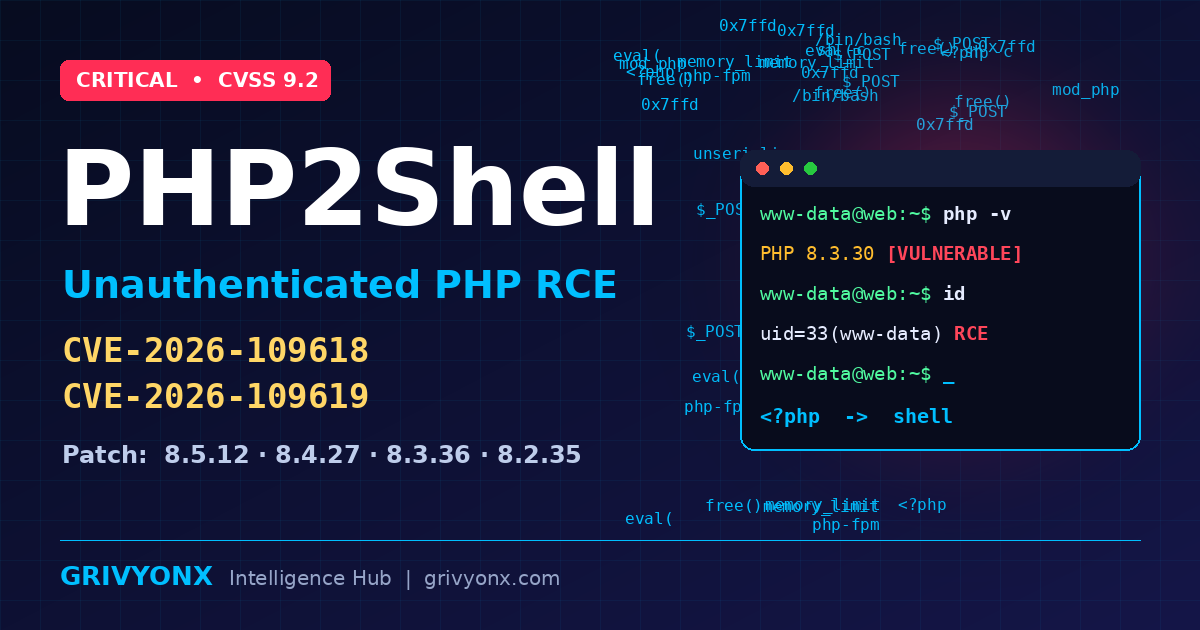
Palo Alto Networks has confirmed that attackers are actively exploiting two vulnerabilities in PAN-OS, the operating system that powers its firewall appliances. The flaws, tracked as CVE-2026-109618 and CVE-2026-109619, are being used against management interfaces that are reachable from the internet. Both allow an unauthenticated attacker to execute code on the device's web server. That single detail reframes the entire incident: the appliance built to guard the perimeter became the way in.
Firewalls have quietly become web applications
The framing that circulated with this exploitation effort, PHP2Shell, is more than a catchy label. It describes an accurate architectural reality. A modern firewall is not only a packet filter. It ships with a management plane: a web interface, an API, logging and telemetry pipelines, and in many cases server-side application code written in languages like PHP. That management plane is the most privileged surface anywhere in the network. It can rewrite routing, open rules, read traffic metadata, and frequently holds credentials or trust relationships to other systems.
Once you accept that the management plane is a web application, the vulnerability classes that apply to it become obvious. Injection, unsafe deserialization, authentication bypass, file upload flaws, and template or interpreter abuse are all in scope. The security team's own control surface inherits the full risk profile of the software stack it runs on, and it inherits it with none of the sandboxing that a normal application would get.
The practical consequence is an inventory problem. Many organisations classify firewalls as network hardware in their asset registers, then apply web application scrutiny only to systems that look like applications. That gap is exactly where an unauthenticated code execution flaw on a management interface goes unnoticed until exploitation begins.
What the two flaws actually allow
Both CVE-2026-109618 and CVE-2026-109619 permit code execution on the web server component without any authentication. There is no credential requirement, no valid session, and no legitimate login step for an attacker to defeat. This is the worst-case entry condition for an edge device, because it removes the one control most organisations implicitly rely on when they leave a management interface reachable: the login screen.
Code execution inside the management web server also means the attacker inherits whatever that component can do. On a firewall, that is configuration authority over the network's traffic policy, visibility into the device's logs, and whatever stored secrets the appliance holds. An adversary in that position does not need to break into a single server. They can reshape the environment around the defenders who are supposed to notice.
Important gaps remain in the public picture. The source material does not disclose the affected PAN-OS versions, the technical root cause of either flaw, CVSS scoring, or the current state of vendor patches. Those details are not yet public, and teams should not assume a version is safe or vulnerable until the vendor advisory is read in full.
Why internet-exposed management interfaces keep causing incidents
This is not a novel pattern, and that is the point. Firewalls, VPN concentrators, load balancers, hypervisor management planes, storage controllers, and out-of-band management cards all share the same trait: a web interface with deep privileges, often patched on a slower cadence than general-purpose servers, and frequently reachable from outside because an administrator once needed remote access during an incident and never removed the rule.
Exposure plus unauthenticated code execution is a short path to compromise. Internet-wide scanning for these interfaces is continuous and automated. The interval between a flaw becoming public and mass exploitation attempts is measured in hours, not weeks, which means the defensive window is defined by how quickly an organisation can identify and reach its own devices, not by how quickly a patch is written.
The disclosure process around these particular flaws also reportedly did not go smoothly, though specifics are not yet public. Whatever the cause, the lesson for defenders is that advisory quality varies. A vendor confirmation of active exploitation should be treated as an actionable signal on its own, without waiting for a complete technical write-up.
What defenders should do now
- Inventory every management interface. Enumerate PAN-OS management planes across all sites, including decommissioned or forgotten units, and record whether each is reachable from the internet.
- Remove internet exposure where possible. Restrict management access to a dedicated management network, a VPN, or a hardened jump host with allow-listing. This is the highest-value control and it does not depend on patch availability.
- Apply vendor remediation as soon as it is available and verify the running software version on each device afterwards. Do not rely on the upgrade having succeeded because the change window closed.
- Hunt for post-exploitation activity. Look for unexpected processes on the management plane, newly created administrative accounts, unexplained configuration changes, web shell artefacts, and outbound connections originating from the appliance itself.
- Review management interface logs for anomalous request patterns, unusual user agents, and access attempts that do not correspond to a known administrative session.
- Rotate credentials and secrets held by or reachable from any device that may have been affected, and check whether those same credentials are reused on other systems.
- Extend the review to peer appliances. If one vendor's web management plane was targeted, assume the same scrutiny applies to other network and infrastructure devices with browser-based administration.
Grivyonx Expert Analysis
The most useful takeaway from this incident is not the CVE numbers. It is that the boundary between network infrastructure and application security has effectively dissolved, and most asset inventories have not caught up. When a firewall's management plane is a web application with root-level authority over your traffic, it deserves the same threat modelling, dependency review, and secure development scrutiny as your customer-facing services. The unauthenticated condition is what makes this severe, but the deeper issue is that these devices are rarely included in application security programmes at all. Organisations that treat every privileged web interface, regardless of the hardware it ships on, as an internet-facing application will consistently find these problems earlier and contain them faster.
Conclusion
Confirmed exploitation of unauthenticated PAN-OS flaws is a reminder that perimeter devices are software, and software has vulnerabilities. The defensive response is unglamorous and effective: know where your management interfaces are, take them off the internet, patch quickly, and assume that any exposed device is a candidate for compromise rather than a trusted asset. Building that discipline into how infrastructure is deployed and reviewed, alongside continuous automated security validation, is where security teams can meaningfully reduce this class of risk, an area where Grivyonx supports organisations through AI-driven automation, DevSecOps practices, and cloud security engineering.
- #PAN-OS
- #Palo Alto Networks
- #CVE-2026-109618
- #CVE-2026-109619
- #PHP2Shell
- #unauthenticated RCE
- #network security
- #vulnerability management